


Author Archives: supremelaws

“Caste Behind Bars”

Caste-based discrimination within Indian prisons remains a deeply troubling yet often overlooked reality. While prisons are meant to function as institutions of correction and reform, they frequently mirror the social hierarchies and prejudices prevalent outside their walls. Despite constitutional guarantees of equality under Articles 14, 15, and 17 of the Constitution of India, the persistence of caste-based practices within prisons raises serious concerns about the protection of fundamental rights of inmates.

One of the most visible forms of caste discrimination in prisons is the assignment of tasks based on caste identities. Reports and studies have revealed that inmates from Scheduled Castes are often compelled to perform menial and degrading tasks such as cleaning toilets or handling waste, irrespective of their willingness or rehabilitation needs. This practice not only reinforces caste hierarchies but also violates the prohibition of untouchability under Article 17. Such institutionalized discrimination undermines the very objective of prisons as spaces for reform and equality.

Further, caste-based segregation among inmates has also been observed in certain prisons. Prisoners are sometimes grouped or housed based on caste affiliations, allegedly to prevent conflicts. However, this often leads to further marginalization and reinforces social divisions. In addition, access to basic facilities, healthcare, and even legal aid may be influenced by caste dynamics, either directly or indirectly, thereby creating an unequal system within an already restrictive environment.

Another critical dimension is the role of prison staff. Prejudices held by authorities can influence decision-making in areas such as work allocation, disciplinary action, and parole recommendations. The absence of strict monitoring mechanisms allows such biases to operate unchecked. Moreover, prisoners belonging to marginalized castes may hesitate to report discrimination due to fear of retaliation or lack of awareness about their rights.

Legal frameworks do exist to address such injustices, including the Protection of Civil Rights Act, 1955 and the Scheduled Castes and Scheduled Tribes (Prevention of Atrocities) Act, 1989, which criminalize caste-based discrimination and atrocities. However, their implementation within prison systems remains weak. The Model Prison Manual also emphasizes equality and non-discrimination, yet compliance varies significantly across states.

Addressing caste-based discrimination in prisons requires a multi-pronged approach. First, there must be strict enforcement of existing legal provisions, coupled with regular inspections and independent oversight by judicial authorities and human rights commissions. Second, sensitization and training programs for prison staff are essential to eliminate deep-rooted biases and promote a culture of equality. Third, transparent mechanisms for grievance redressal must be established, ensuring that inmates can report discrimination without fear. Legal aid services should also be strengthened to empower prisoners to assert their rights.

Additionally, work allocation within prisons should be based on skill, choice, and rehabilitation goals rather than caste identity. Educational and vocational programs must be made accessible to all inmates equally, fostering an environment of dignity and self-improvement. Civil society organizations can also play a crucial role in monitoring prison conditions and advocating for reform.

Gaurav Goel, Senior Partner at Supreme Laws, aptly observes, “A prison cannot become a site where constitutional rights are suspended; equality must prevail even behind bars.” He further emphasizes, “Assigning work on the basis of caste is not just discriminatory—it is a direct affront to the constitutional vision of dignity and justice.” His statements highlight the urgent need to align prison practices with constitutional mandates.

Echoing similar concerns, Advocate Tarlok Singh states, “Reformative justice loses its meaning if prisons replicate the very inequalities they are meant to correct.” This perspective underscores the importance of transforming prisons into spaces that uphold, rather than violate, fundamental rights.

In conclusion, caste-based discrimination in prisons is a serious violation of human dignity and constitutional principles. Addressing it requires not only legal enforcement but also a shift in institutional mindset. True justice lies in ensuring that even the most marginalized individuals are treated with equality and respect, regardless of where they are.
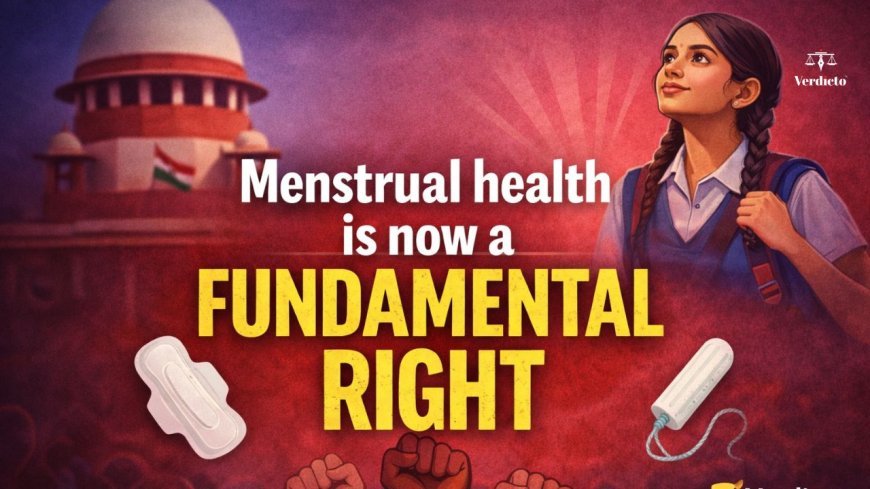



“Menstrual Hygiene: A Fundamental Right” – Honourable Supreme Court

The recognition of menstrual hygiene as a fundamental right by the Supreme Court of India marks a transformative moment in constitutional jurisprudence and gender justice. It reflects a progressive understanding that biological realities such as menstruation must not become barriers to education, dignity, or equality. In its landmark 2026 judgment, the Court firmly held that the absence of adequate menstrual hygiene facilities in schools violates fundamental rights guaranteed under Articles 14 and 21, as well as the right to education under Article 21A.

At the heart of the ruling lies a powerful principle: a girl’s education must not be interrupted simply because of her natural biological cycle. The Court observed that lack of access to sanitary products, clean toilets, and awareness leads to absenteeism and, in many cases, permanent dropouts. Studies placed before the Court highlighted alarming figures, with millions of girls missing school or discontinuing education due to menstrual-related challenges. This reality was recognized as a structural barrier, one that transforms a biological condition into systemic discrimination.

By declaring menstrual health an intrinsic part of the right to life and dignity, the Court expanded the scope of Article 21. It emphasized that dignity is not limited to mere survival but includes conditions that enable individuals to live with self-respect and equal opportunity. The judgment also adopted the doctrine of substantive equality, acknowledging that true equality requires addressing the specific needs of women rather than treating everyone identically.

The Court issued clear and enforceable directions to both the Union and State governments. These include ensuring free sanitary napkins in schools, constructing functional gender-segregated toilets, providing safe disposal mechanisms, and incorporating menstrual health education into school curricula. These measures are not welfare schemes but constitutional obligations, aimed at ensuring uninterrupted access to education for girls.

Legal experts and practitioners have widely welcomed this progressive interpretation. Gaurav Goel, Senior Partner at Supreme Laws, remarked, “Menstrual hygiene is not a matter of charity but a constitutional guarantee rooted in dignity and equality.” He further observed, “When a girl misses school due to lack of basic facilities, it is not just a social failure but a violation of her fundamental rights.” Emphasizing the transformative nature of the ruling, he added, “The judgment rightly recognizes that education must be accessible in reality, not merely in law.”

Supporting this perspective, Gaurav Goel also noted, “This decision ensures that no girl is forced to choose between her biology and her education, thereby strengthening the very foundation of gender justice in India.” These statements reflect a broader legal consensus that the judgment bridges the gap between formal rights and lived realities.

Ms K Meenal, a noted legal commentator, also endorsed the Court’s observation, stating, “By linking menstrual hygiene with fundamental rights, the Court has dismantled a long-standing barrier that silently pushed girls out of classrooms.” Her statement underscores the importance of recognizing hidden forms of discrimination that operate within everyday life.

Ultimately, this judgment is more than a legal directive—it is a social milestone. It challenges stigma, compels institutional accountability, and reaffirms that the Constitution is a living document capable of responding to evolving societal needs. By ensuring that menstruation does not end a girl’s education, the Court has reinforced the idea that equality must be meaningful, inclusive, and grounded in reality.

Justice – Access to a Common Man

Access to justice for the common man is a cornerstone of a democratic society and a fundamental promise of the Constitution of India. In a country marked by vast socio-economic diversity, ensuring that every citizen—irrespective of their financial or social status—can approach the courts is both a challenge and a necessity. The Indian legal system, guided by the principles of equality before law and equal protection of laws, aims to make justice not just a privilege for the few but a right accessible to all. Institutions like the Supreme Court of India and various High Courts have consistently emphasized the importance of making justice delivery more inclusive and efficient.

Despite these ideals, the reality often reflects significant barriers for the common man. High litigation costs, procedural complexities, lack of legal awareness, and delays in the judicial process can discourage individuals from seeking justice. For many, navigating the legal system becomes overwhelming, leading to a sense of helplessness. However, progressive measures such as legal aid services, Lok Adalats, and the expansion of Public Interest Litigation (PIL) have helped bridge this gap to some extent. These mechanisms have allowed individuals and groups to raise their voices and seek remedies without being burdened by technicalities or financial constraints.

Highlighting the importance of accessibility, Gaurav Goel, Senior Partner at Supreme Laws, observes, “Justice must not remain confined within the walls of courtrooms; it should be felt and experienced by the common man in his everyday life.” He further emphasizes, “True democracy is reflected not merely in the existence of laws, but in the ease with which an ordinary citizen can enforce his rights without fear or financial hardship.” His perspective underscores the idea that accessibility is as important as the delivery of justice itself, and that reforms must focus on simplifying procedures and reducing delays.

Adding to this viewpoint, Tarlok Singh, Advocate at Supreme Laws, states, “The strength of a legal system lies in its ability to reach the weakest sections of society and provide them timely and effective remedies.” This reflects the growing recognition within the legal fraternity that justice must be people-centric. Technology has also begun to play a transformative role in this regard, with e-courts, virtual hearings, and online filing systems making legal processes more accessible, especially in remote areas. Such innovations have the potential to reduce geographical and logistical barriers that once limited access to justice.

In conclusion, ensuring justice for the common man is not merely a legal obligation but a moral imperative for a democratic nation like India. While significant strides have been made, continuous efforts are required to make the legal system more transparent, affordable, and efficient. By strengthening legal aid, embracing technology, and fostering a more responsive judicial approach, India can move closer to realizing the ideal where justice is truly accessible to all. Voices like Gaurav Goel and Tarlok Singh serve as important reminders that the ultimate goal of the legal system is to serve the people, especially those who need it the most.

What is The role of judiciary in good governance

The judiciary plays a foundational role in ensuring good governance by upholding the rule of law, protecting fundamental rights, and maintaining the balance of power among the organs of the State. In any democratic setup, governance is considered “good” when it is transparent, accountable, equitable, and responsive to the needs of the people. The judiciary acts as the guardian of the Constitution, ensuring that all legislative and executive actions conform to constitutional principles. By exercising the power of judicial review, courts have the authority to invalidate laws and policies that are arbitrary, unjust, or unconstitutional. This function acts as a crucial check against misuse of power and helps prevent authoritarian tendencies. As Gaurav Goel, senior partner at Supreme Laws aptly states, “An independent judiciary is the backbone of a functioning democracy, ensuring that power is never exercised without accountability.” Moreover, an impartial judicial system instills public confidence, reassuring citizens that their rights will be protected without bias or influence. Without such oversight, governance may become arbitrary and discriminatory, thereby eroding democratic values.

Another vital aspect of the judiciary’s role in good governance is the protection and enforcement of fundamental rights. Courts serve as the ultimate forum for individuals seeking justice against violations by the State or other entities. Through mechanisms such as Public Interest Litigation (PIL), the judiciary has expanded access to justice, especially for marginalized and disadvantaged sections of society. This has allowed courts to intervene in matters concerning environmental protection, human rights, corruption, and administrative inefficiency. Highlighting this transformative role, Gaurav Goel observes, “The proactive approach of the judiciary, particularly through PILs, has democratized justice and given a voice to those who would otherwise remain unheard.” By doing so, the judiciary not only resolves disputes but also actively contributes to policy shaping and social transformation. Judicial activism, when exercised with restraint and responsibility, strengthens governance by compelling authorities to act within the framework of law and public interest. At the same time, the judiciary must maintain a delicate balance and avoid overstepping into the domain of the executive or legislature, thereby respecting the doctrine of separation of powers.

Furthermore, the judiciary contributes to good governance by promoting transparency, accountability, and efficiency within public administration. Through its judgments, it sets standards for administrative conduct and compels public authorities to act in a fair, reasonable, and non-arbitrary manner. The courts have repeatedly emphasized the importance of natural justice, due process, and reasoned decision-making, which are essential elements of accountable governance. In cases of corruption or abuse of power, judicial intervention often acts as a corrective mechanism, ensuring that those in authority are held answerable for their actions. Emphasizing this critical function, Gaurav Goel remarks, “A vigilant judiciary acts as the moral compass of governance, ensuring transparency and reinforcing the faith of citizens in public institutions.” Additionally, the judiciary plays a significant role in interpreting laws in a dynamic manner, adapting them to changing social and economic conditions. In essence, the judiciary not only safeguards legal and constitutional values but also acts as a catalyst for ethical governance, ensuring that governance remains people-centric, fair, and just.

Judicial Activism In India – Perspectives

Judicial activism in India has emerged as a powerful tool to uphold the rule of law and protect fundamental rights, especially in situations where legislative or executive actions fall short. The Indian judiciary, led by the Supreme Court of India, has played a proactive role in addressing issues ranging from environmental protection to human rights and governance reforms. By expanding the scope of Public Interest Litigation (PIL), courts have made justice more accessible to marginalized and disadvantaged sections of society. Judicial activism thus reflects the judiciary’s commitment to ensuring that constitutional values are not merely theoretical but effectively implemented in practice.

Over the years, judicial activism has significantly contributed to shaping India’s socio-legal landscape. Landmark judgments have addressed concerns such as corruption, gender equality, and environmental degradation, often stepping into areas where policy gaps existed. While critics argue that such activism may sometimes blur the line between the judiciary and the legislature, supporters believe it acts as a necessary check and balance in a democratic system. In a country as diverse and complex as India, judicial intervention often becomes essential to maintain fairness, accountability, and justice.

According to Gaurav Goel, Senior Partner at Supreme Laws, judicial activism is not an overreach but a responsibility. He states, “Judicial activism strengthens the foundation of democracy by ensuring that no authority remains unchecked when citizens’ rights are at stake.” Emphasizing its importance further, he adds, “In a dynamic society like India, the judiciary must evolve beyond passive interpretation and actively safeguard constitutional morality.” His views highlight how judicial activism acts as a guardian of justice, especially in times when institutional inertia may delay necessary action.

Another perspective is offered by Gaurav Goel, who remarks, “Judicial activism serves as a voice for the voiceless, bridging the gap between law and real justice in society.” These insights underline the constructive role of the judiciary in addressing pressing social issues. In conclusion, judicial activism in India remains a vital instrument for promoting justice, protecting rights, and ensuring governmental accountability. When exercised with restraint and responsibility, it continues to strengthen public trust in the legal system and uphold the spirit of the Constitution.

Disclaimer

As per the rules of the Bar Council of India, we are not permitted to solicit work or advertise in any manner. By proceeding further and clicking on “I Accept” below, the user acknowledges that the transmission, receipt or use of the information on our website does not tantamount to solicitation, advertisement, inducement or personal communication of any sort for and on behalf of the Firm so as to create an attorney-client relationship.

The information provided herein should not be interpreted as legal advice, for which the user must make independent inquiries. Whilst every effort has been taken to ensure the accuracy of the contents of this website, Supreme Laws disclaims all liability arising from reliance placed by the user or any other third party on the information contained therein.