

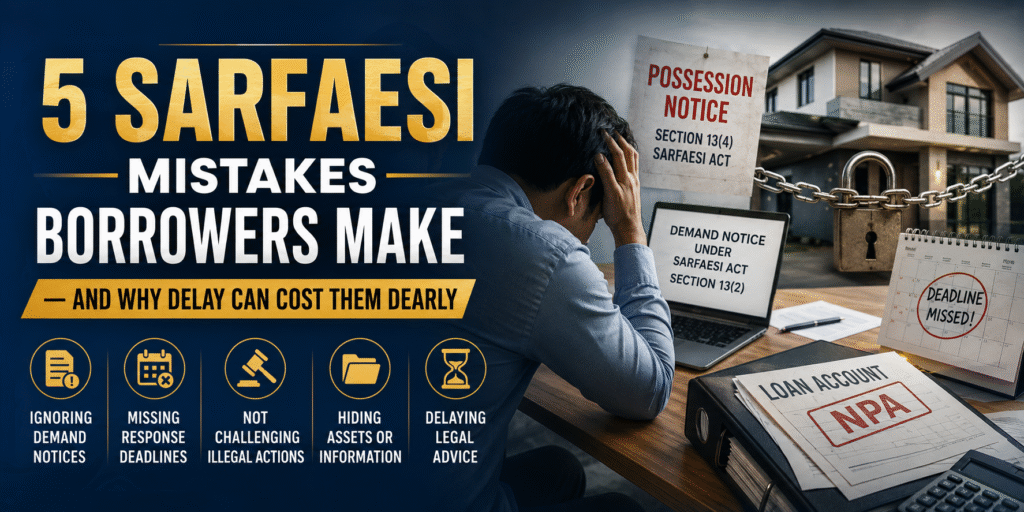
When a borrower receives a SARFAESI notice, the first reaction is often emotional rather than legal: “The bank cannot take my property.” That assumption can be costly. The SARFAESI Act gives secured creditors a statutory route for enforcing security interests, while also providing borrowers with specific opportunities and remedies at different stages of the process. One of the biggest mistakes borrowers make is therefore ignoring the first demand notice. A Section 13(2) notice should not be treated as routine correspondence. It is the point at which the borrower should verify the outstanding amount, examine the loan account, check the security documents and identify any genuine dispute concerning the bank’s claim. A borrower who waits for possession or auction before taking advice may find that valuable time has already been lost.
The second mistake is responding emotionally instead of responding intelligently. A letter saying that the borrower is suffering financial hardship or requesting the bank to “give some more time” may not address the actual legal or factual issues in the account. If there are genuine discrepancies, they should be supported with documents and clearly presented. The third mistake is assuming that a technical defect automatically wipes out the bank’s entire claim. It does not. A borrower may identify an irregularity in possession, valuation or sale proceedings, but that does not necessarily mean the underlying debt has disappeared. The enforcement process has to be examined as a whole, including compliance with the Security Interest (Enforcement) Rules, which prescribe requirements concerning possession notices, valuation, reserve price and sale of immovable secured assets.
The fourth mistake is waiting until the property is advertised for auction before exploring legal remedies. Once possession and sale formalities have progressed, the borrower may have to act quickly and within the applicable statutory framework. Section 17 provides a remedy before the Debts Recovery Tribunal against measures taken under Section 13(4). At the same time, borrowers should carefully distinguish between a genuine legal challenge and an attempt merely to postpone repayment. Gaurav Goel, Senior Partner, Supreme Laws, says: “A borrower should not mistake the availability of a legal remedy for a licence to ignore a genuine financial liability. Where the bank has followed the prescribed procedure, the borrower must have a substantive and legally sustainable basis for opposing enforcement.” He further cautions that litigation without a realistic strategy can sometimes reduce the borrower’s options rather than improve them.
The fifth mistake is failing to think about resolution alongside litigation. A borrower may have a legitimate objection to a particular enforcement step and still need to address the underlying financial liability. Depending upon the facts, discussions concerning repayment, restructuring or a negotiated settlement may therefore deserve consideration alongside appropriate legal proceedings. From the bank’s perspective, recovery of secured dues is not merely an administrative exercise; it is the enforcement of a contractual and statutory right, subject to compliance with law. The Rules require, among other things, valuation by an approved valuer and fixation of a reserve price before sale of an immovable secured asset. Gaurav Goel adds: “Banks cannot be expected to keep recovery proceedings indefinitely in abeyance when public or institutional funds remain outstanding. A borrower who genuinely wants to protect the property should act early, place a credible proposal before the lender where appropriate, and pursue only those legal objections that can withstand scrutiny.” The practical lesson is simple: do not ignore SARFAESI, do not rely solely on technicalities, and do not wait until the auction date to decide what to do.