

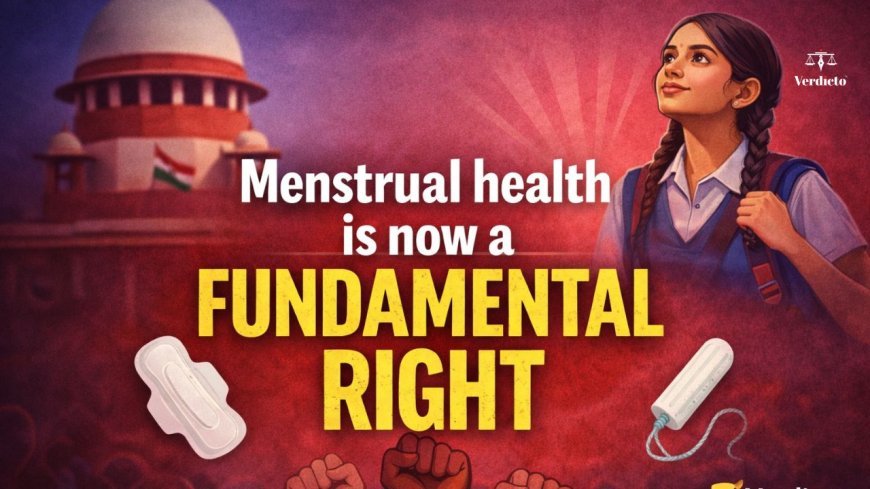
The recognition of menstrual hygiene as a fundamental right by the Supreme Court of India marks a transformative moment in constitutional jurisprudence and gender justice. It reflects a progressive understanding that biological realities such as menstruation must not become barriers to education, dignity, or equality. In its landmark 2026 judgment, the Court firmly held that the absence of adequate menstrual hygiene facilities in schools violates fundamental rights guaranteed under Articles 14 and 21, as well as the right to education under Article 21A.
At the heart of the ruling lies a powerful principle: a girl’s education must not be interrupted simply because of her natural biological cycle. The Court observed that lack of access to sanitary products, clean toilets, and awareness leads to absenteeism and, in many cases, permanent dropouts. Studies placed before the Court highlighted alarming figures, with millions of girls missing school or discontinuing education due to menstrual-related challenges. This reality was recognized as a structural barrier, one that transforms a biological condition into systemic discrimination.
By declaring menstrual health an intrinsic part of the right to life and dignity, the Court expanded the scope of Article 21. It emphasized that dignity is not limited to mere survival but includes conditions that enable individuals to live with self-respect and equal opportunity. The judgment also adopted the doctrine of substantive equality, acknowledging that true equality requires addressing the specific needs of women rather than treating everyone identically.
The Court issued clear and enforceable directions to both the Union and State governments. These include ensuring free sanitary napkins in schools, constructing functional gender-segregated toilets, providing safe disposal mechanisms, and incorporating menstrual health education into school curricula. These measures are not welfare schemes but constitutional obligations, aimed at ensuring uninterrupted access to education for girls.
Legal experts and practitioners have widely welcomed this progressive interpretation. Gaurav Goel, Senior Partner at Supreme Laws, remarked, “Menstrual hygiene is not a matter of charity but a constitutional guarantee rooted in dignity and equality.” He further observed, “When a girl misses school due to lack of basic facilities, it is not just a social failure but a violation of her fundamental rights.” Emphasizing the transformative nature of the ruling, he added, “The judgment rightly recognizes that education must be accessible in reality, not merely in law.”
Supporting this perspective, Gaurav Goel also noted, “This decision ensures that no girl is forced to choose between her biology and her education, thereby strengthening the very foundation of gender justice in India.” These statements reflect a broader legal consensus that the judgment bridges the gap between formal rights and lived realities.
Ms K Meenal, a noted legal commentator, also endorsed the Court’s observation, stating, “By linking menstrual hygiene with fundamental rights, the Court has dismantled a long-standing barrier that silently pushed girls out of classrooms.” Her statement underscores the importance of recognizing hidden forms of discrimination that operate within everyday life.
Ultimately, this judgment is more than a legal directive—it is a social milestone. It challenges stigma, compels institutional accountability, and reaffirms that the Constitution is a living document capable of responding to evolving societal needs. By ensuring that menstruation does not end a girl’s education, the Court has reinforced the idea that equality must be meaningful, inclusive, and grounded in reality.